Mise en Mat: The Daily Practice of Emmanuel Stroobant
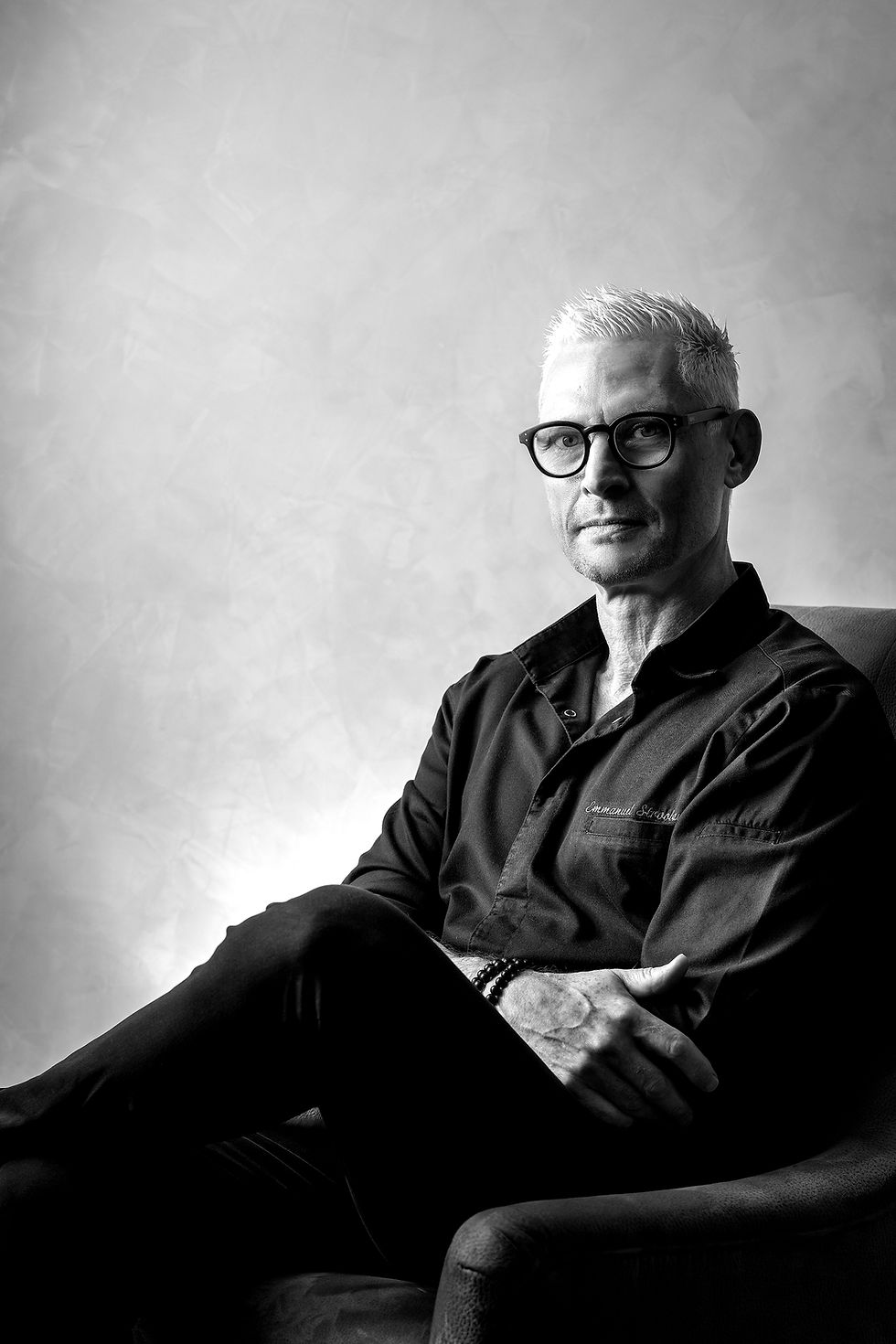
The first thing you notice about Emmanuel Stroobant is that he does not look like a man who cooks for a living.
When he rises to greet me in the kitchen of his Sixth Avenue home, he is wearing a fitted black V-neck T-shirt and loose linen trousers. His hair is cropped short, flecked with silver. His body is compact and muscular, the body of a former boxer — broad shoulders, thick in the torso, built more for a ring than a restaurant. There is a roughness to him, a raw masculinity that feels at odds with the restrained refinement of the plates he serves at his restaurants.
The 57-year-old is best known as the Belgian-born chef behind Saint Pierre, one of Singapore’s longest-running fine-dining institutions, and Shoukouwa, an omakase-style Japanese restaurant. Both hold two Michelin stars.
Over the years he has expanded into television, books and other hospitality ventures, building an enviable reputation that blends classical French technique with Japanese precision and a deep engagement with Asian ingredients.
When he describes himself, however, the image he portrays is not quite the polished portrait you might expect.
“For the longest time,” he says with a laugh, gesturing down his arms and miming a cigarette and a drink. “I used to be like, tattoos everywhere — Harley Davidson, smoking cigars, drinking whiskey. That kind of chef.” He breaks into a broad grin, his eyes bright with mischief.
He says it half-jokingly, but it reflects the real-world intensity of professional kitchens — particularly the generation in which he came up, where being tough was often synonymous with authority.
Many chefs still see it that way. Stroobant does not. What he values today is something far less showy and harder to sustain.
“Reliability is your secret weapon,” he tells me early in our conversation, describing how yoga has changed his outlook since he started practising almost 20 years ago.
In Stroobant’s world, reliability has little to do with talent and everything to do with showing up — whether in the kitchen or on the mat.
That change did not happen overnight.
It began, unexpectedly, with music.
From the ring to the mat
He had always been physical. Boxing and martial arts were already something he did regularly. One day, in his 30s, while training for a white-collar boxing competition at a gym, Stroobant heard music from another room. Through the window he could see a yoga class in progress.
“There were guys doing yoga on the other side of the window with the music quite strong,” he says. “And I really enjoyed the music. I thought, I have to try a yoga class.”
In his first class, there was no spiritual revelation.
What was revealed was that he could barely touch his knees.
He was told he should try hot yoga. So he did.
At a yoga studio nearby, he began practising five days a week, sometimes more, fitting classes into the awkward split shifts of restaurant life. He loved the sweat, the grit, the familiar feeling of pushing himself to the edge. At first, that was enough. Yoga, in those early years of his practice, was purely physical. It was simply another demanding thing the body could do.
That soon changed — first, through Carlos Pomeda, a Sanskrit and religious studies scholar whose teachings helped Stroobant decode the shapes he was making on the mat. Pomeda taught him not just the poses, but the philosophy behind them.
“He made me understand why I was doing those asanas,” Stroobant says. “That flipped everything.”
Then came Andrei Ram, a world-renowned teacher whom he still refers to as “my real teacher”. Stroobant describes walking into a lift and seeing a man standing beside him. “That man was beautiful,” he says. “I couldn’t express it. There was something stunning about him.”
That man turned out to be the teacher of the class he was about to take.
Ram, who was ordained by Sri Dharma Mittra, offered something Stroobant had not yet been able to piece together: the physical practice, the philosophy and, crucially, meditation.
He describes an early meditation lesson with Ram. Why, Ram asked him, could he not simply sit in peace? Because a mind burdened by unfinished tasks, neglected responsibilities, and unexamined conduct cannot settle easily, Ram said.
For Stroobant, that flipped another switch: meditation was not just about posture or technique, but about the conditions that make stillness possible.
A retreat in Colombia with Ram followed in 2013, and with it, a vow.
If he wanted to teach that lineage seriously, Ram told him, he would need to commit to practice in the way a priest commits to a calling. So he did.
“My vow was to practise daily, whatever happens, going back home at 4am, a little bit tipsy because of my work, whatever happens,” he says. “I made a vow, and I have never, ever missed a single day of practice for 13 years.”
Mise en mat
The cliché of chef as tyrant still hangs over fine dining: the shouting, the humiliation, the relentless pressure in the name of upholding standards, popularised by television shows like Hell’s Kitchen and Kitchen Nightmares.
Stroobant, who began his culinary career at age 16, and opened his first restaurant at 23, in Liege, Belgium, knows that world intimately.
“I grew up with this,” he says. “It’s my background.” But he looks at it differently now. Yoga, he says, helped him realise that “screaming and violence” are not the best way to lead a team.
“What it taught me was to control my reaction, to control my emotions.”
He gestures towards the kitchen behind where we are sitting, which is modelled on the one in his restaurant. If a waiter drops a tray of plates on the pass — the narrow counter where chefs finish dishes and servers collect them — his old reaction would have been rage. But rage would not have solved the problem.
“Banging my fist on the table would not bring the plates back,” he says. So instead, he has learnt to respond calmly: “Okay, you know, please come clean this. Waiter, go tell the customer that he will have to wait five more minutes, offer him a glass of wine. Chef, start a new dish.”
The example is unremarkable, perhaps, but it reveals something deeper about how the father of two now sees the world.
He has little patience for dramatics, whether in kitchens or in life. People, he says, complain too easily. They mistake inconvenience for suffering. Missing a bus becomes a personal catastrophe. But in another place, he points out, there might not be a bus at all. For him, perspective matters.
Whenever he sees migrant workers riding in the back of lorries on his drive home, it snaps him out of self-pity every time, he says.
“Why am I complaining?” he asks himself. “Look at those guys.” He knows he has worked hard for the life he has. But he also knows others are working hard too.
“It’s just I had a chance,” he says, “and that is something which I will be thankful for the rest of my days, rather than taking things for granted.”
That language of gratitude surfaces again when Stroobant, who is a vegetarian, speaks about yoga more directly. Not as passive acceptance, but as santosha — contentment, or at least a sense of being grounded that keeps you from being thrown around by every irritation, delay or wounded ego.
“If you don’t get upset, you start seeing things with a smile,” he says. “Because you put on a smile, and you start having smiles around.”
None of this means he has become soft. If anything, he has become more exacting about what deserves his attention. He is skeptical of paper qualifications without real depth, suspicious of teachers who skim the surface of traditions they claim to represent, and impatient with spiritual posturing.
“I’m not a guru,” he says. “That’s certainly not an image I ever, ever, ever want to project.”
Are we there yet?
His own practice now reflects that shift. These days he wakes at 6.30am, drives his daughters to school, then begins his practice around 8am.
First weights, then asana, then breathing and meditation. Sometimes, on his way to work, he parks his car near the Botanic Gardens, rolls down the windows, and meditates for as long as 40 minutes, while listening to birds sing.
“I like birds, I like nature. It inspires me,” he says.
He still practises headstands every day. “That is the pose,” he says. “It gives me my standard.” Like a chef tasting a dish again and again, the practice tells him exactly how he feels that day: tired, distracted, or fully present.
“I know that recipe is always the same, so I can judge if it’s too salty or not too salty. I know what it should taste like.”
As the interview draws to a close, I glance back into the kitchen. Copper pots and pans catch the afternoon light. Along the wall, knives sit on individual wooden shelves, each carefully displayed, like objects in a small museum.
The contrast that shaped my first impression of him — a boxer’s rough physicality versus a chef’s delicate artistry — no longer feels like a contradiction. What connects the two is the same discipline: the patience to repeat the same work again and again, without complaint.
“Slow is the fastest way to go where you want to go,” he says.
It’s an idea that runs quietly through everything we have talked about. In yoga, where he recalls the satisfaction of inching, millimetre by millimetre, into a forward fold he once thought impossible; and in cooking, where a dish comes together only after years of repetition and refinement.
Perhaps in life too, where the real work is not arriving somewhere impressive, but returning — reliably, day after day — to the practice that makes getting there possible.
“We always forget the value of the travel before we reach the destination,” Stroobant says, with a glint in his eye. “Having something is not fun. Getting something — that’s the interesting part.”


Comments