Upside Down, Inside Out: Getting to Know the Obsessive Practice of Victor Chau

Victor Chau is the kind of yoga teacher other yoga teachers look up to.
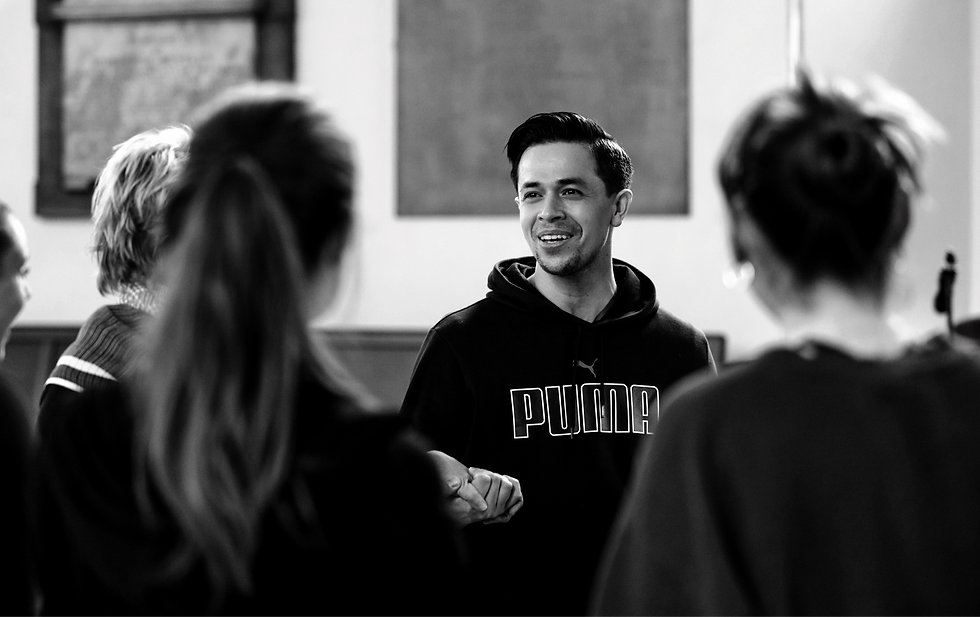
Tall, lean, and tanned, he meets me as the lift opens to his floor in an apartment in Orchard Road. His hair is neatly combed, posture relaxed but upright. He greets me with the practised warmth of someone used to being at the front of a room.
It’s 3pm in the afternoon, and his home is quiet, spacious, filled with natural light. During the interview, we sit outside on his balcony that overlooks the back of the street’s iconic shopping centres. His dog Pudding, an adopted companion with a gorgeous, creamy coat the colour of the dessert it’s named after, is resting by my feet. I hear Skimbleshanks, his other pet, a black feline, somewhere in the background. His partner, a fashion director at an international brand, is at work.
By any conventional measure, Victor’s professional trajectory is similarly impressive: a career in luxury fashion PR, then years of teaching yoga in Beijing, Hong Kong and around the world in more than 20 cities. One of Lululemon’s earliest ambassadors in Hong Kong, the youthful 46-year-old has almost 11,000 followers on Instagram.
It is the kind of CV that charts a seamless ascent in the yoga world — one any full-time yoga teacher, including myself, would be envious of.
But the story I’m here to listen to begins with a fall.
The fall that started it all
His “obsession” — as he put it, began in India. In 2010, after more than 10 years of working in public relations, and practising yoga, he decided to take up teacher training in an ashram by the Ganges River.
During his training, he remembers falling in countless handstand attempts while another trainee, who was a gymnast, kicked up effortlessly.
“She just did it,” he recalls. “Like it was nothing.”
That lit up something in him. A curiosity sharpened by the thrill of a challenge.
He tells the story plainly, as if there’s no need to explain his obsession: You see what’s possible, you realise you can’t do it, you decide you will.
It’s that simple.
After his training ended, he began to seek out teachers who were known for getting upside down. They included Dice Iida-Klein and Briohny Smyth, whose acrobatic moves had already begun influencing global yoga culture long before “influencer” was a job description; Miguel Sant’ana, whose workshops brought Brazilian athleticism into yoga spaces; and Yuval Ayalon, a Paris-based handstand teacher whose refinement of the practice left a lasting impression on him.
Victor didn’t just attend their classes. He tracked down trainings and workshops and practised tirelessly. “Once something grips me,” he says, “I want it.”
The confession comes with a knowing smile — the kind people wear when they know they have a trait that’s not going to change. He describes it as something fixed early in his childhood: As a kid, if he wanted a toy, he would “beg and bug and annoy” his parents until he got it, he says.
The adult Victor can afford his own toys now, but he’s still the same kid.
When it came to inversions, that meant repetition with a laser-like focus: kick up, fall, kick up, fall, kick up again. Thirty or 40 times in a single practice session — every day.
“Just one of my practice sessions already includes more handstands than what most people do in a year,” he says, explaining why many practitioners stay stuck at the wall.
“If you want to improve on something, you need to put in the work,” he says. “Even on days you don’t feel like doing it, you still do it.”
But his point isn’t really about effort for effort’s sake. The more he talks about how his inversion practice has evolved, the clearer it becomes that he no longer treats a perfectly executed handstand as the prize.
“Yes and no,” he says, when I ask if inversions are still his favourite type of pose to practise. Handstands, he now says, are “just one way of moving the body”.
When willpower hits a wall
I came to the interview prepared to talk about inversions, but we quickly dive into his other “obsessions” — after all, his first encounter with handstanding in India happened more than 15 years ago.
His eyes light up when he starts talking about the sea. And that’s when I notice — Victor’s face is handsome in a way that’s perfect for the camera — strong features, symmetrical, expressive, but up close I can see the faint weathering around his eyes, the kind that doesn’t come from studio lights but from years of sun, salt air, and squinting into open water.
For the past few years, that water was Hong Kong’s.
Before moving to Singapore, his home was five minutes from the sea. On clear mornings — and many not-so-clear ones — he would venture out on his paddle board, sometimes in fog so thick that the horizon disappeared. He would pick up his compass, call up Google Maps on his phone, and go out to sea anyway. People worried. His mother, knowing what he was like, would call him during typhoon warnings to make sure he wasn’t out there.
But then he learnt to read the weather. To track wind. To respect currents. Out there, he says, you realise very quickly how insignificant you are. You can be strong, confident, have years of experience at sea, and still entirely be at the mercy of something larger.
It’s a theme that shows up too when he talks about baking sourdough bread — another long-running fixation of his, before it became a pandemic hobby.
In bread, he says, the ingredients are simple: water, flour, salt. The starter itself is water and flour. His early loaves, he admits, were often delicious but “hard as bricks”. He kept adjusting technique, hydration, shaping — but nothing worked.
He couldn’t understand why, until he watched a video that changed the way he thought about baking. There was a fourth ingredient, the baker said: time.
And Victor, who had always wanted everything “right now,” had an a-ha moment.
“I wanted it now,” he says, amused at his younger self, “But the dough doesn’t care.”
The different threads of our conversation begin to come together. Listening to him move from handstands to weather systems to bread, what strikes me is not how different these fixations are, but how similar.
In each one, Victor begins the same way. With the belief that if he pushes hard enough, he can get to where he wants to go.
But out at sea, strength doesn’t matter if the current turns. In baking, ingredients and technique don’t accelerate time. And in handstands, practice can only take you so far; balance comes when you let go of your fear of falling.
“Every time you come up to a handstand or inversion, it's like you're trying to find that oh shit moment — ‘I'm going to fall down.’ … Every time, once you find that moment where you feel like you're falling down, it's actually where you need to be.”
For someone whose instinct, since childhood, has been to keep pushing, he seems most drawn to practices that keep teaching him to surrender.
An inversion of a different kind
Victor officially moved to Singapore in July last year. At first, he arrived on a tourist visa. It took another two to three months to secure an Employment Pass — a process he describes as paperwork-heavy but, in hindsight, surprisingly smooth.
Compared with the stories he has heard from other foreigners, he considers himself “very, very fortunate”.
Still, logistics aren’t the only challenge.
He had delayed the move, he admits, not because he didn’t want to come, but because he loved the life he had built in Hong Kong. He loved where he lived — and especially the fact that the sea was just five minutes from his front door.
Not so here in his Orchard Road condo.
The water sports scene here, he says, is more fragmented, more expensive to navigate; the sense of open, everyday access he had before isn’t the same.
He is candid about the emotional side of starting over. Despite his partner living and working in Singapore, he has had to set himself up independently. There is the practical business of building a network, finding the “right kind of people”, figuring out where he fits in a new landscape.
“I’m not just staying here for a year or two,” he says. “I want to really make it work.”
It’s a line that reminds me of our how our conversation started: with his obsession with handstands — except, this time, the balance hasn’t quite arrived.
As we wrap up, the late-afternoon light shifts across his apartment. Below us, Orchard Road hums — the faint rhythm of a city like the one he used to live in. Pudding lifts his head, stirs, and settles back at my feet.
Victor sits up in his chair and looks out of the balcony. From this height, the world looks still. But he knows better than most: balance is never fixed. It’s something you keep finding, one small adjustment at a time.

Comments