From Rishikesh to Sathorn: Sandeep Singh on Yoga’s Roots & its Future

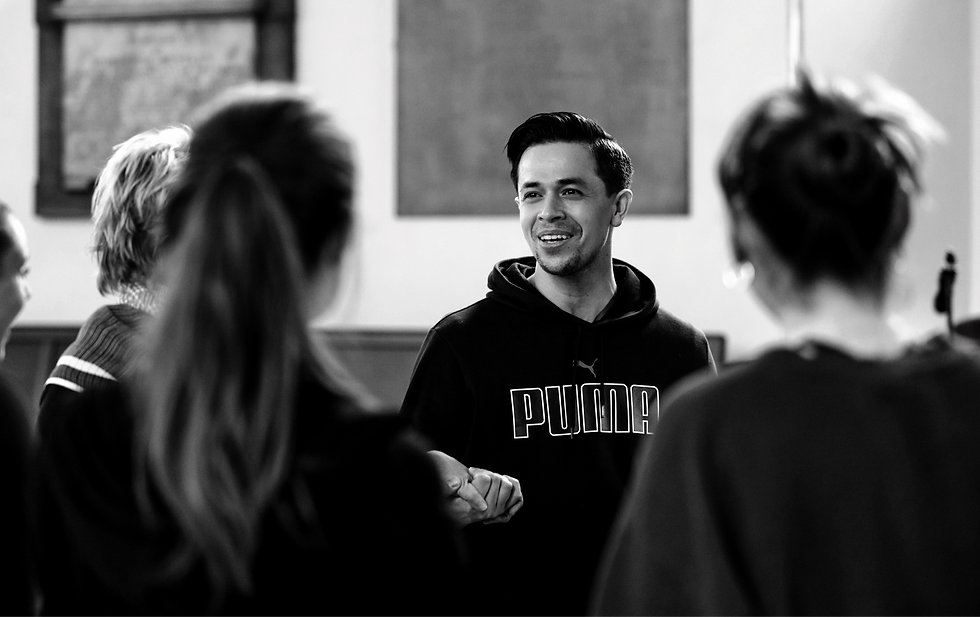
Sandeep Singh arrives for our interview the way he arrives for class: already in uniform. A tank top, loose pants, and a kind of calm readiness that suggests the day has been running long before I pressed record.
We’re 32 floors up at Sathorn Nakhon Tower, in a lounge that feels almost too bright—Bangkok’s morning light pouring through the studio’s large windows, making everything look photoshoot-ready. It’s an oddly fitting setting for a conversation about yoga in 2026: elevated, polished, a little removed from the everyday. And yet, if you listen closely, still rooted to something ancient and enduring.
He smiles often, with an ease that makes you want to relax too. But there’s seriousness underneath it: he shifts his posture when he’s thinking, leaning in slightly as if the right alignment might help the right sentence to land. When I ask if he had time to look over the questions I sent, he says, “Just a little” — but his answers, measured and reflective, suggest the opposite. This is, he tells me, his first interview. He admits he’s a bit nervous. The honesty makes him more charming, not less.
He has been teaching yoga for nearly 13 years, and has lived in Bangkok for almost 12 of them. He’s 35 now — meaning that most of his adult identity as a teacher has been forged in Thailand, not India. He teaches at Yoga Sutra in Sathorn, and, in the last two years, has also become what many teachers quietly dream of becoming and quietly fear becoming: a studio owner. His new space is in Chatuchak. He does much of the teaching himself, supported by Thai teachers; he is currently the only Indian teacher on the roster. “Very busy now,” he says, without complaint. After our interview, he’ll teach two classes in Sathorn, then head across town to teach more at his own studio.
This shape of life — a full schedule, split loyalties, work that begins before sunrise and extends beyond dinner — is familiar in the yoga world. What’s less common is the clarity with which Sandeep can name what he’s doing and why he’s doing it. His story isn’t just about building a career in Bangkok; it’s about translating a practice across cultures without flattening it into a product. And, perhaps more than that, it’s about holding onto responsibility in a profession that is increasingly incentivised to entertain.
Even his name contains a small lesson in adaptation.
“I usually use this,” he says, when I ask about the name he goes by. “Actually, my full name is Sandeep Singh Rana.” In school, the surname was dropped. Later, paperwork and habit cemented the shortened version. He could use Rana, he says, but it complicates things — people might assume he’s someone else. So he stays Sandeep Singh. Not out of branding strategy, but out of practicality: “It can be misunderstanding,” he says almost sheepishly.
Misunderstanding — of names, of meanings, of yoga itself — threads through much of what we talked about.
Sandeep was born and raised in Rishikesh, the Himalayan city that has become, for many, synonymous with yoga pilgrimage. “Everybody goes to Rishikesh,” he says, with a little laugh, and adds Mysore as the other inevitable point on the map. But he doesn’t romanticise his childhood there. If anything, he de-mythologises it.
“My earliest memory,” he says, “yoga was nothing too special. Not like separate. It was like a way of life.” He remembers sadhus by the river — men sitting still, meditating, practising pranayama — though, as a teenager, he didn’t understand what he was watching. He just watched. Yoga, in his description, wasn’t a class you sign up for; it was part of the atmosphere. Posters on the street. Elders practising. Friends who knew the shapes of yoga because they were surrounded by them.
His family didn’t have a yoga background, he says. He didn’t inherit it at home. He stumbled into practice the way most teenagers do: through friends. “At first, I just go for the practice… just for fun,” he says. He was 17 or 18, in college, and yoga was simply an activity, another way to move, another way to pass an afternoon. Then, after a few months, it started to work on him in a deeper way.
“I realise it’s changing my body,” he says, “and the same time… my attitude.” That line lands with quiet conviction, like it still surprises him. It’s the pivot point: the moment yoga stops being something you do, and becomes something that does something back.
In India, he explains, “you do not go for 200 hour, 300 hour.” The now-global teacher training structure wasn’t the primary route. Instead, he pursued what he calls “proper education”: a one- or two-year university programme, a diploma, a degree, and the possibility of a PhD. He considered the PhD, he says, but opportunities came, as they do, and he chose to work instead.
“It’s kind of a mix of opportunities, and curiosity,” he says. He had begun teaching in India, and then a friend already in Thailand told him about a job opening. He was 23 or 24 — his first time leaving India. His family, while supportive, missed him, of course. And in that era, before the ease of video calls, the distance felt farther. Still, he made the leap.
When I ask what surprised him most about his journey from Rishikesh to Bangkok, he pauses, then answers with a sentence that could be a thesis statement for the global yoga industry — if it weren’t so personal.
“As I see, the yoga has travelled far… and it still remains yoga,” he says. “It feels like yoga does not just belong to one country. It adapts.”
Adaptation is a lovely idea until you have to live it. When he arrived in Bangkok, Sandeep taught the way he had been trained: gentle, breath-led, with awareness and pranayama. It did not go well.
“Honestly,” he says, “I got really very bad feedback.” His early classes were described as slow, easy — too soft for people who wanted their yoga to feel like fitness. “People really don’t want to get that deep,” he says. “They just want… more physical workout.”
Here, Sandeep is careful not to sound reproachful. He doesn’t dismiss the students. He treats their expectations as a reality a teacher must meet. He learned to teach differently, not by abandoning the deeper practice, but by changing the doorway.
“Asana could be the first door for you,” he says, brightening as the metaphor arrives. “As you enter the temple… the yoga temple.”
It’s a gentle reframing: you don’t have to begin with philosophy to eventually arrive at it. In fact, he admits, he didn’t begin with the ethical limbs of yoga either.
“I don’t know… yama, niyama,” he says, recalling his younger self. “We’re enjoying the practice… and then slowly we realise this whole other thing.”
What he is protective of is not how people enter yoga, but the integrity of where it is supposed to lead.
The current 200-hour and 300-hour trainings are designed for those who cannot stay in India for one or two years, he says. He doesn’t reject these new systems of training; he understands why they exist. But he’s frank about their limits. “Not enough, never,” he says. “Yoga is very deep.” Even 500 hours cannot cover it all. At best, he suggests, these programmes can teach something more important than shapes.
“You’re not going to learn yoga actually,” he says. “You’re going to learn how to live your life.”
In the West — and increasingly across Asia — he observes that teacher training often becomes a study of sequencing. Sequencing has value, he says, and he uses it too. But the deeper question: why you practise, what the goal of yoga is beyond the asanas, can get lost, especially in studio culture where time is limited and expectations are high.
“You cannot teach them history or philosophy,” he says. “They just need their workout… their sweat.” The job becomes subtler: “As much as you can, try to make them connected for one hour.”
Connection is his recurring metric. When I ask what makes a class well taught, he doesn’t say alignment. He doesn’t say peak pose. He doesn’t say how many people attended. He says something both disarmingly simple and surprisingly direct.
“When the people leave the studio,” he says, “they should smile on their face.”
If they don’t smile, he assumes he didn’t do his job. He wants them more connected than when they arrived. Sweat is fine. But the point is feeling. “It’s all about feeling,” he says, and he means it.
He’s also realistic: not everyone will respond the same way. A room of 15 contains 15 versions of readiness. Some will want depth; some just want flexibility. “It’s okay,” he says. “We accept that.” The teacher’s work, as he sees it, is not to force philosophy onto unwilling people, but to keep offering the possibility of something more — sometimes through a steady class, sometimes through humour, sometimes through conversation.
“Only the asana is not enough,” he says. “Sometimes you can release their tension, their anxiety, just by the talking.”
This is where his critique of modern yoga sharpens. He doesn’t object to yoga evolving; he insists it must. “Yoga must evolve,” he says. “But do not forget its roots.” The line he cannot tolerate is when yoga becomes pure gimmick: wine yoga, beer yoga, pet yoga. He sighs, almost pained. “As a fun way, okay,” he concedes. “But don’t call it yoga.”
If there’s one contradiction he’s struggling with, it’s this: yoga’s global popularity has created opportunities for teachers like him to build meaningful lives abroad — but the same popularity can hollow the practice out. His response isn’t purity policing. It’s responsibility.
One of his university teachers told him that yoga is a responsibility — something you must share “in the right way.” Sandeep carries that idea like a quiet vow. It shows up again when we talk about being an Indian teacher in Thailand. He notes that many Thai students prefer Indian teachers — partly because teachers from India, which is the birthplace of yoga, must know best. He admits he feels pride. Then he corrects himself: “But the same time… responsibility too.”
Owning a studio intensifies that responsibility. His studio is called Yog Abhyas Bangkok — and he insists on the language. “It’s not a yoga,” he says gently. “It’s a yog.” Yog: the Sanskrit root. Abhyas: practice. No hype, no promise of transformation in 10 sessions. Just practice — daily, imperfect, sincere.
He tells me he offers more pranayama, more depth, more meditation, more awareness in movement. In his own space, he has more ability to shape the experience, to nudge students beyond the purely physical.
At the end, I ask a deliberately light question: one pose everyone should practise more. He resists the premise. One pose can’t do anything, he says; you need the whole practice. But he offers an answer anyway: Tadasana. Stand, rise onto your toes, stretch from head to foot. Begin with simplicity.
When I ask where he goes to unwind in Bangkok, he doesn’t name a fashionable bar or a new restaurant. He says he likes mountains, quiet cafés, the open water. And when I ask what he misses most about India, his voice drifts back to Rishikesh.
“The Ganga River,” he says. “The silence of early morning.”
He means the Ganges River — a sacred, 2,500 km long river flowing from the Himalayas through northern India and Bangladesh to the Bay of Bengal, but whose true name is Ganga.
It’s not a conclusion so much as a return to where it all began. And with that, he checks the time, straightens his posture, and goes to teach.

Comments